Heroes and Sheroes
Do you want excitement or comfort?
If it makes it easier to answer, we’re just talking about from books. There’s no wrong answer to this question. Well, except that obviously exciting is better. Obviously. Why? Because it’s grander, grittier, and goddammit, just more heroic than a comfort read. It is, after all, the Hero’s Journey (Joseph Campbell™). You know, those stories where an “increasingly isolated protagonist stomps around prodding evil with pointy bits, eventually fatally prods baddie, gains glory and honor.” From Odysseus to Jack Reacher, this story’s part of our DNA. So wouldn’t it be weird to realize we’ve been telling another very different story all along too?
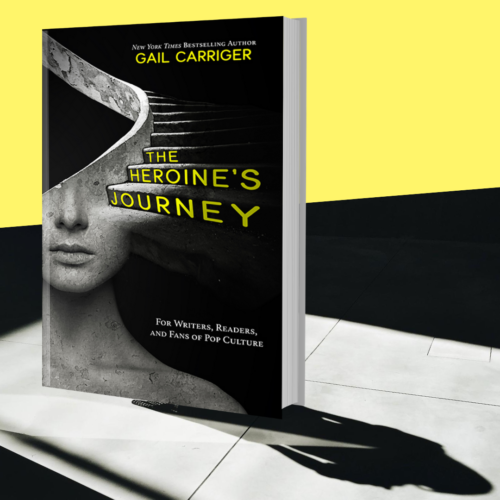
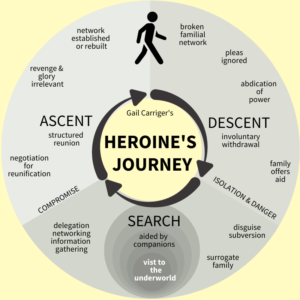
Half craft book, half pop culture critique, and all rallying cry against the patriarchy, Gail Carriger’s The Heroine’s Journey isn’t like any writing book I’ve encountered before. In contrast to our stompy loner of the Hero’s Journey, Carriger dials up three ancient goddess myths to kickstart the equally ancient Heroine’s Journey. You can check out her flow chart – or better yet read the book – but her one-sentence summary is: “Increasingly networked protagonist strides around with good friends, prodding them and others to victory together.” Now doesn’t that sound like a comforting conclusion?
You’ll not be surprised to learn I’m Team Heroine. Most fans of Romance, as well as cosy mysteries, comedies, and a whole lot of YA are. Yes, we’re here for the feel-good. But while Carriger’s given me plenty of pleasurable confirmation bias as a reader – yes! I’m that much more ready to fend off imagined snubs at entirely fictitious cocktail parties – she’s also given me plenty of tools for self-criticism as a writer. I mean, are my heroines truly on the Heroine’s Journey?
Look, I instinctively liked the move away from Old School Romance heroines who were set adrift in a sea of adversarial males. We need 21st century heroines with lots of kinship and female allies because that’s what we need from life generally. But from a narrative perspective, the ‘woman alone’ trope works for the pure and simple reason that it forces an otherwise sensible heroine to depend upon the heartless rake, the faithless pirate, or, in my case, the unscrupulous fortune hunter that sails into her life.
My current WIP is a series about a trio of hard-to-land Victorian heiresses. But if these Inconvenient Heiresses don’t make it easy for prospective partners, then I certainly don’t make life easy for them. In each book, the heroine strikes out on her own and battles unforeseen obstacles on unfamiliar ground: my Boston shipping heiress arrives in London to find her sister’s family facing financial ruin at the hands of speculators and black-market traders. My Birmingham manufacturing heiress flees the country after falling for the cheap seductions of a second-rate rake, only to find herself incognito and in danger in Egypt as the British start bombing the city of Alexandria. And my final heiress is packed off as a penniless spinster on one of the so-called ‘Fishing Fleets’ to India – only to be overwhelmed by opportunists upon embarking in a foreign city a newly rich woman.
After reading The Heroine’s Journey, I’m revisiting each of these setups and asking: am I giving my heroines enough allies? It’s a given that the heroes will be by their side. But their objectives can’t, shouldn’t, be the same as the heroines’. I mean, where would the sexual tension come from? But more fundamentally, where would her true power as a heroine come from if her victory was simply securing a nuclear family? She needs a community setting in order to really come into her power.
I’m in the process of writing the final Inconvenient Heiresses book and I can already see Carriger’s work reflect in my creation of the secondary and tertiary characters. I’ve given this last heiress the shittiest of all the heroes – in fact, he was so shitty that he was the villain in Book 1 – and she absolutely cannot rely on him. But of course she will. That’s her power. This type of character befriends everyone. Sees the positive in everyone. And that is where the misfit crowd of tricksters and stowaways she’s mixed up with is essential for letting her shine – and shine so bright that even the hero with no moral compass can walk his redemption arc.
Carriger also makes me wonder if some of my male MCs shouldn’t have a shot at their own Heroine’s Journey. This model wouldn’t work for the more unreconstructed exemplars of toxic male masculinity – their allegiance to the Hero’s Journey is part what of makes their collision with the Heroine’s so juicy – but what about my charming spy (think the Scarlet Pimpernel crossed with Lord Peter Whimsey)? Caught in the Alexandria Bombardment, he’s a natural networker, delegating away and constructing a social ladder to safety out of the rubble. Really, I’d like to see more double HJs in Romance generally.
So, yeah, I choose comfort. But not complacency. It’s really restorative and recalibrating work that we do as writers and readers of the Heroine’s Journey. And, thanks to Carriger, I newly appreciate how essential the creation of that community is for storytellers – on the page and off.